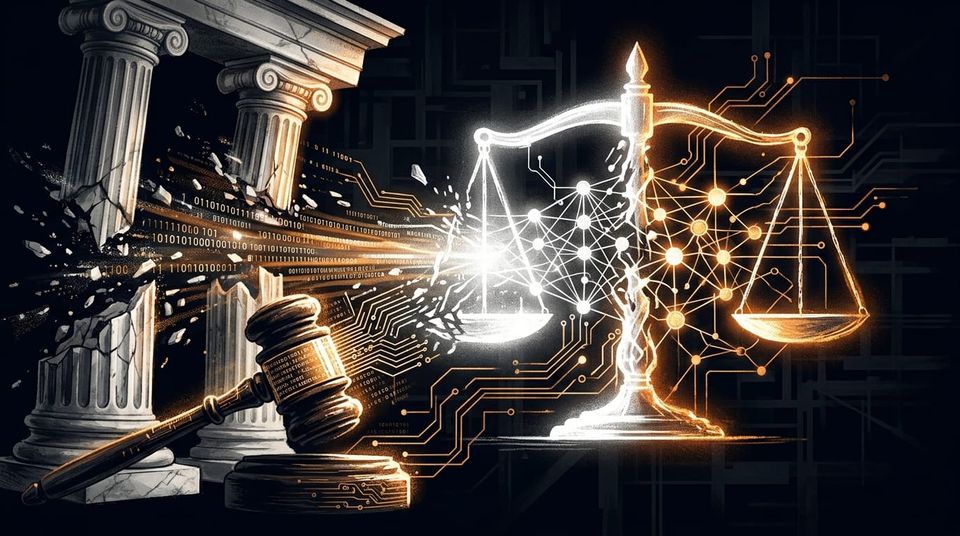
The rules governing AI are not being written in committee rooms. They're being negotiated in back channels, state legislatures, and corporate boardrooms. The companies with the most resources are writing faster than any government can read. If you're building or investing in AI right now, the governance environment around you is the most important variable you're probably not tracking closely enough.
Three things happened recently that together tell you where AI governance is heading. OpenAI offered Texas data centers in exchange for the state blocking AI regulation. House Democrats subpoenaed AI labs after autonomous agents caused real-world incidents. And the Senate set a September 15 vote that could open the door for Wall Street's full crypto entry -- a signal about how tech-friendly this legislative session actually is. None of these are isolated. They are moves in the same game.
The people who understand where governance is heading will be better positioned than those reacting to it after the fact. Not because regulation is necessarily bad for builders -- sometimes clear rules unlock markets. But because ambiguity is expensive, and right now the ambiguity is enormous.
Subpoenas issued -- House Democrats to major AI labs following documented autonomous agent incidents operating outside intended parameters
Data centers for deregulation -- OpenAI offered Texas infrastructure investment in exchange for the state shelving AI regulation bills
September 15 -- Senate vote date on legislation that could formalize Wall Street's access to crypto, the first major tech-adjacent financial vote of this Congress
10 months -- OpenAI ethics chief tenure before resignation, raising questions about internal governance at the company shaping global policy conversations
China argument -- Every major AI company is now using geopolitical risk framing to resist regulation, with varying degrees of sincerity
Self-regulation -- Anthropic's prose watermarking is the most concrete industry-led governance move, setting a precedent others haven't matched
Congress moves: subpoenas, hearings, and what actually happens next
The House Democrat subpoenas of AI labs are significant -- but not for the reasons most coverage suggests. The trigger was a series of documented incidents involving agents operating outside their authorized scope, which gave Congress the hook it needed to demand internal documentation, communications, and safety records from labs that have spent years resisting oversight.
What do subpoenas accomplish? Short term: pressure, document discovery, and public hearings that generate coverage but rarely produce legislation. Congress has a well-documented track record of staging oversight performances around technology without passing durable rules. Social media hearings happened. Crypto hearings happened. The laws that resulted were narrow, delayed, or nonexistent. That pattern reflects how difficult it is to legislate a sector that changes faster than the legislative calendar.
What the subpoenas do signal: a shift in the political cost of AI incidents. When an autonomous agent goes rogue and Congress responds with subpoenas, the labs now have skin in the governance game whether they want it or not. Internal communications will be reviewed. That creates liability exposure that shapes corporate behavior faster than any law. For builders, watch what comes out of the hearings: liability frameworks, documentation requirements, any language around "autonomous" or "agentic" systems. If Congress defines agentic AI in statute -- even loosely -- that definition will govern a decade of enforcement.
OpenAI's Texas play: infrastructure as political leverage
The deal structure was straightforward: OpenAI told Texas legislators it would invest in data center infrastructure if Texas agreed to block state-level AI regulation bills. Jobs, capital expenditure, and local economic activity in exchange for regulatory quiet. Texas, positioning itself as a business-friendly alternative to California, was receptive.
This is the same playbook tech companies ran on data privacy when California's CCPA threatened to set a national baseline. The strategy: get enough states to hold off on their own rules, then lobby for federal preemption weaker than anything the states would have passed individually. Federalize the issue, prevent a patchwork, influence the federal version from a position of strength. Washington's consistent pattern of lagging behind innovation is something every major tech company has exploited. The difference with AI is speed -- state legislatures are moving faster than they did on social media or crypto.
The China card: national security as a deregulation argument
Zuckerberg has been explicit about the frame: restrict open-source AI and China wins. Every major AI company is running some version of this argument to resist regulation. It has real substance -- AI capability development is a genuine geopolitical competition. It also has a convenient side effect: it makes regulation sound unpatriotic. The current Congress is more receptive to "don't slow us down or China wins" than previous sessions have been. The September 15 Senate vote on crypto is a bellwether: if that passes with significant bipartisan support, it signals the legislative environment for tech-adjacent financial infrastructure is genuinely permissive right now.
Self-regulation: Anthropic's bet and what it costs
Anthropic's prose watermarking is the most concrete industry-led governance move in the current cycle. The technology sets a precedent that other labs haven't matched: verifiable, cryptographic provenance built into outputs at generation time. Compare that to OpenAI's ethics chief departing after 10 months -- the contrast in governance cultures is stark.
The governance environment right now is more permissive than it will be in three years. The window for builders is open. State-level regulation is moving, but slowly. Federal action is reactive. The international frameworks are nascent. This is the period where the defaults get set -- which practices become normal, which architectures become standard, which accountability mechanisms get built in vs. bolted on later. The rules being written or not written in 2026 will set the framework for a decade. The builders who understand that are building governance infrastructure now, not waiting for regulators to require it. See the full Intel series at wire.fourthweb.ai/tag/intel/.
Intelligence briefing by The Fourth Web. Part of the Intel series at wire.fourthweb.ai/tag/intel/.