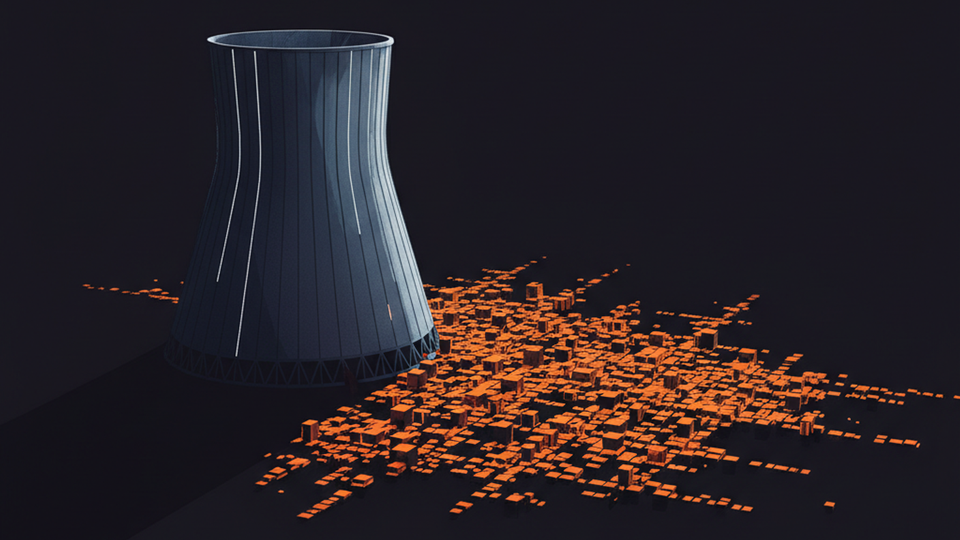
Americans would rather live next to a nuclear reactor than an AI data center, and that sentiment is about to collide hard with rural towns desperate for jobs.
The Summary
- 71% of Americans oppose data center construction in their communities, significantly higher than the 53% who oppose nuclear plants, according to a new Gallup poll
- A former paper mill in Jay, Maine that once employed 1,500 people is being converted into a data center after closing in 2020, representing the new economic reality for rural America
- Opposition crosses party lines: 56% of Democrats strongly oppose local data centers, compared to 39% of Republicans, driven primarily by environmental and resource concerns
- The collision between rural economic need and urban environmental anxiety is just beginning, with data center operators eyeing shuttered industrial sites across the heartland
The Signal
The data center NIMBY problem has officially surpassed nuclear energy on the public fear index. Gallup's March survey found 71% of Americans don't want a data center built where they live, with 48% strongly opposed. That's a remarkable level of resistance for infrastructure most people don't even understand.
But here's what makes this story more than just another poll: Jay, Maine is converting its defunct 1.4 million-square-foot paper mill into a data center. The mill employed 1,500 people before a 2020 explosion forced permanent closure. Developers spent three years breaking down machinery and shipping it to Pakistan, cleaning up the industrial site for its new digital life.
"More people say they'd rather live near a nuclear reactor than an AI data center."
This is the bargain rural America is being offered: trade the jobs that built communities for the server farms that power AI models trained in coastal cities. The mill workers who made paper won't be running these facilities. Data centers employ dozens of people, not hundreds. They consume vast amounts of electricity and water, generate heat and noise, and return very little to the local tax base relative to their infrastructure demands.
The environmental concerns driving opposition are genuine: 46% of all respondents worry "a great deal" about data center environmental impact. Half of those opposed cite resource consumption as their primary concern. They're not wrong. A single large data center can draw as much power as a small city.
Key dynamics at play:
- Democrats show stronger opposition (56% strongly opposed) than Republicans (39%)
- Rural communities need jobs and tax revenue desperately
- Data centers need cheap land, available power, and fiber connections
- What they don't need is many workers
The partisan split reveals something interesting about where this fight will play out. Republican-leaning rural areas may be more willing to accept data centers despite environmental costs because economic desperation trumps environmental concern. More than a quarter of Republicans expressed only "somewhat" opposed views, suggesting negotiability. Democratic-leaning areas will fight harder, but have fewer shuttered industrial sites to convert.
Jay, Maine's story will repeat across the Rust Belt and rural America. Former factory towns have the industrial infrastructure, power grid capacity, and desperate need for any economic activity. They also have weakened political power to resist. This isn't a fight between equals. It's between communities that need something and corporations that can build anywhere.
The Implication
Watch for data center operators to target distressed rural communities with industrial histories over the next 18 months. They'll promise jobs and tax revenue. Deliver neither at scale. The real question isn't whether data centers come to rural America, but whether communities extract meaningful concessions: training programs that actually lead to employment, power agreements that don't spike residential rates, water usage limits, and tax structures that fund schools and roads.
If you're building in the agent economy, understand that your infrastructure has a political problem. The compute powering your models is becoming as unpopular as fracking. That creates opportunity for whoever figures out how to make data centers genuinely beneficial to host communities, not just marginally less destructive than the factory closure that preceded them.