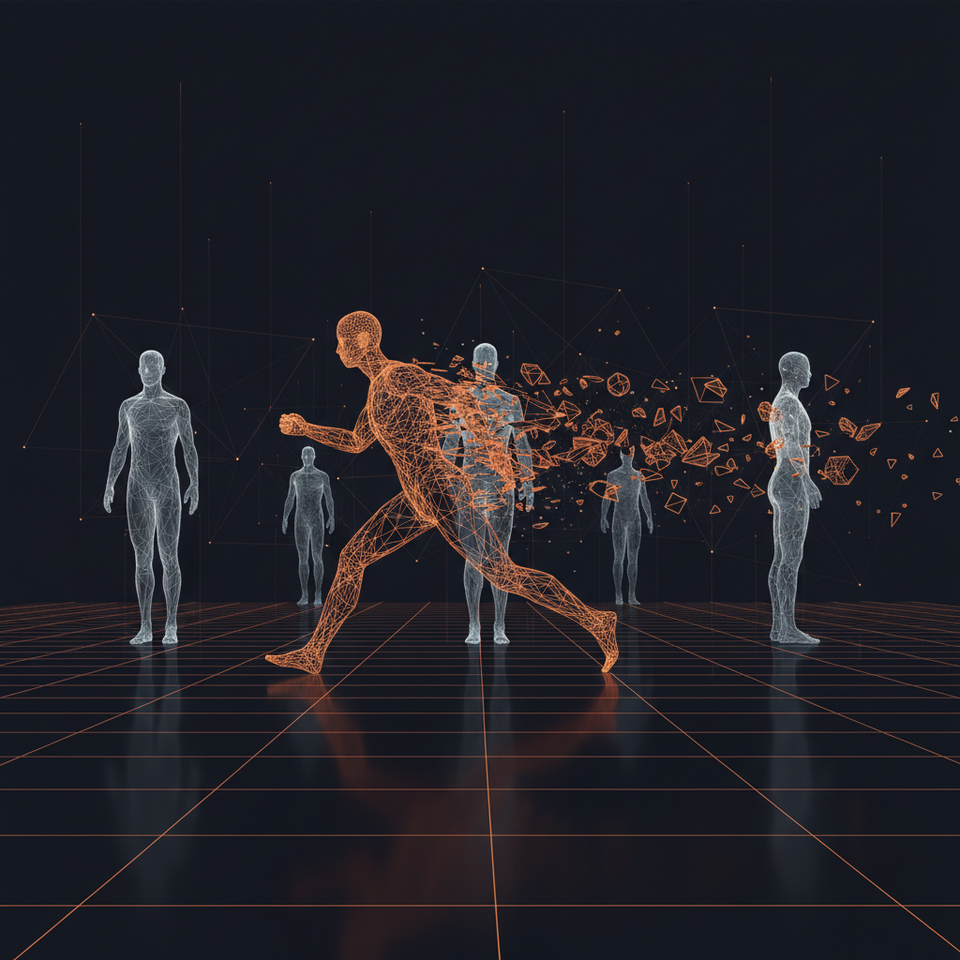
A Chinese humanoid robot just ran a half-marathon seven minutes faster than the world record, and the most interesting part isn't the speed.
The Summary
- A red humanoid robot completed a 21km half-marathon in Beijing in 50:26, beating the human world record by seven minutes
- The demonstration signals China's accelerating focus on embodied AI and physical automation at scale
- What matters isn't that robots can now outrun humans, it's that the control systems needed to sustain bipedal motion for 50 minutes are approaching production readiness
The Signal
The robot completed 21 kilometers without falling over, overheating, or running out of power. That's the actual achievement here. Humanoid robotics has always been less about raw speed and more about balance, energy efficiency, and control systems that don't catastrophically fail under sustained physical stress.
Seven minutes faster than the human record sounds impressive until you realize this wasn't competing against humans. It was demonstrating endurance at a pace that would destroy most prototype robots within minutes. The fact that it finished means the underlying tech, power management, motor control, and real-time decision-making systems held up under the kind of sustained operation that actual deployment requires.
"Fifty minutes of continuous bipedal motion is the embodied AI equivalent of a model inference running for hours without hallucinating."
China's robotics companies have been quiet about benchmarks while Western labs published papers. This is a marketing move, but it's marketing something real. The country that dominates physical automation, especially humanoid platforms that can navigate human-built environments, controls the next layer of the agent economy. Software agents need bodies to interact with the physical world. Those bodies need to work for more than a demo.
Compare this to Tesla's Optimus, which has shown impressive dexterity in controlled environments but hasn't demonstrated this kind of endurance in the wild. Or Boston Dynamics' Atlas, which does parkour but isn't designed for marathon operation. The Chinese approach appears focused less on viral moments and more on operational stamina, the thing that matters when you're deploying thousands of units in warehouses, hospitals, or factories.
Key capabilities this demonstrates:
- Power systems that sustain load for nearly an hour
- Balance algorithms that handle varied terrain without human intervention
- Thermal management under continuous physical stress
The timing matters too. This happens as China doubles down on "new productive forces," the policy framework pushing AI and robotics as core economic infrastructure. A half-marathon isn't a product. It's a signal of readiness, a proof point for investors, manufacturers, and governments that humanoid robots are past the prototype stage and entering the "we can deploy these" phase.
The Implication
If you're building in the agent space, start thinking about embodiment as infrastructure, not science fiction. The robots that matter won't be the ones doing backflips. They'll be the ones that can work an eight-hour shift, recharge, and do it again tomorrow. China just showed that capability gap is closing faster than most people in the West expected.
Watch which robotics companies start talking about endurance metrics instead of speed or dexterity. That's where the real race is happening.