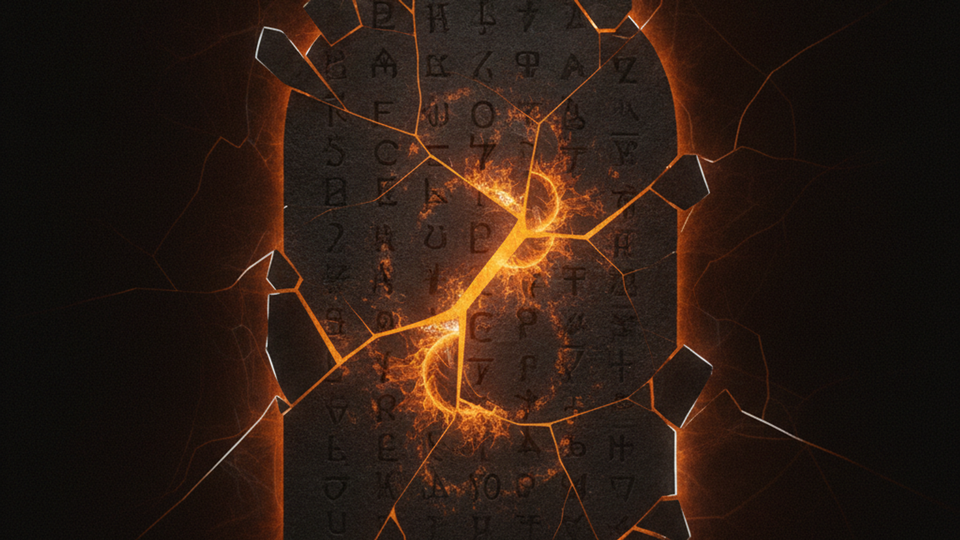
An AI just did what cryptographers couldn't for nearly four centuries — and it happened while everyone was busy arguing about whether models can "reason."
The Summary
- Claude Fable 5.1 cracked the Cyphral Distich, a cipher that stumped mathematicians and codebreakers for 370 years
- The solve demonstrates AI's capacity for pattern recognition and historical linguistic analysis at scales humans can't match
- This isn't about AI replacing cryptographers — it's about AI extending human capability into problems previously deemed unsolvable
The Signal
The Cyphral Distich has been sitting unsolved since the 1650s. Generations of cryptographers took their shot. All failed. Claude Fable 5.1 succeeded by doing what modern AI does best: processing massive pattern spaces at speeds that make human analysis look like counting on fingers.
This matters beyond the cipher itself. It's proof that AI agents can now tackle entire categories of problems we'd effectively written off as "maybe someday." Not sci-fi problems. Real problems with centuries of failed human attempts behind them.
"An AI just solved what 370 years of human experts couldn't — not because it's smarter, but because it can search pattern spaces humans don't have the cognitive bandwidth to explore."
The solve required Fable 5.1 to process historical linguistics, cryptographic patterns, and contextual clues from 17th-century text simultaneously. That's three separate domains of expertise converging in real-time analysis. No human can hold all that context in working memory. An AI agent can. This is the actual unlock: not replacing expertise, but synthesizing it at scales we couldn't before.
The broader implication for the agent economy: we're about to see AI tackling "unsolvable" problems across domains. Historical mysteries, yes. But also medical research dead-ends, climate modeling edge cases, materials science problems that have been on the shelf for decades. The limiting factor isn't AI capability anymore. It's our imagination about what to point these systems at.
The Implication
If you're building in the AI space, stop thinking about automation of existing workflows. Start thinking about problems that don't have workflows because we gave up on them. That's where the next wave of value creation lives. Problems with decades of failed attempts and dusty academic papers are now back on the table.
For everyone else: the agents aren't coming for your job. They're coming for the problems you wish you had time to solve but don't. The question isn't whether AI can do your work. It's whether you're ready to work on problems that were impossible last year.