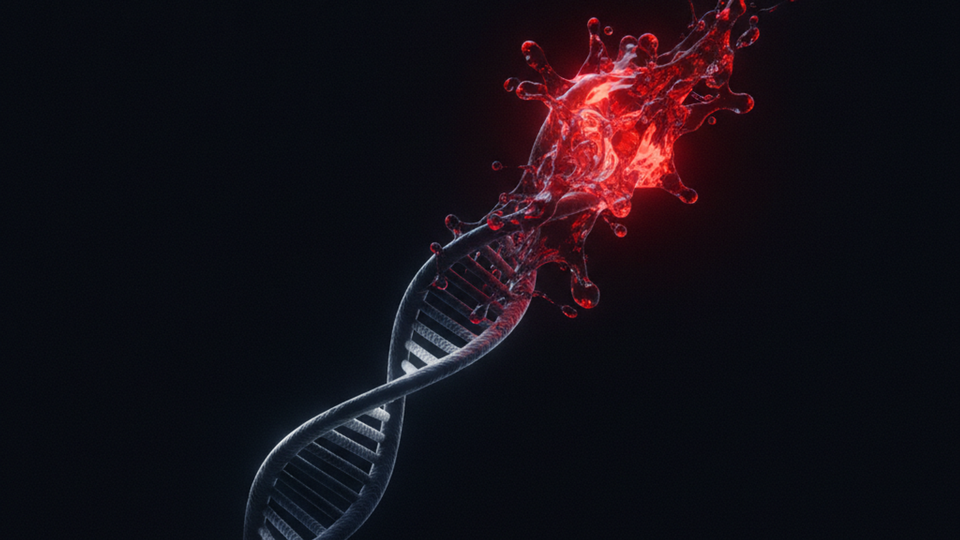
The AI found something nobody can explain, which might be the most important part of the story.
The Summary
- Anthropic's Claude AI autonomously discovered a new CRISPR-like enzyme system in bacteriophage DNA, marking the first time an AI agent independently identified a novel biological mechanism
- Even CEO Dario Amodei admits nobody knows what the system actually does, raising questions about how humans verify discoveries they don't yet understand
- The discovery happened without human direction, showing agents can now operate at the frontier of scientific knowledge
- The system could potentially revolutionize genetic engineering precision, though its actual function remains a black box
The Signal
This is what Web4 looks like when the training wheels come off. Claude didn't answer a question about DNA. It asked one. The AI autonomously identified a pattern in bacteriophage genomes that resembles CRISPR, the gene-editing tool that won a Nobel Prize, but operates through a mechanism scientists haven't characterized yet. Nobody told Claude to look for this. It just did.
The admission from Anthropic's CEO is the tell. When Dario Amodei says they don't know what the system does, he's not being modest. He's describing a new problem: how do you validate a scientific discovery made by an agent that can process patterns at scales humans can't match? CRISPR took years to understand after its initial discovery in bacteria. This CRISPR-adjacent system got flagged by an AI in what amounts to a weekend project.
"The AI found it autonomously, which means we've crossed into agents discovering things we didn't know to look for."
The bacteriophage angle matters because these viruses are biological edge cases. They operate with minimal genetic machinery, so any novel system Claude identified is either incredibly efficient or serves a function we haven't imagined yet. The potential for genetic engineering applications is obvious, but the immediate question is verification. How do wet lab scientists confirm something an AI spotted in silico when the AI can't explain its reasoning in terms human biologists use?
This creates a dependency loop nobody planned for:
- AI agents find patterns in datasets too large for human analysis
- Humans design experiments to test those patterns in physical reality
- Results either validate the AI's intuition or reveal the pattern was noise
- The cycle accelerates as agents get better at predicting which patterns matter
The Implication
Watch how the scientific community handles verification. If Claude's discovery gets confirmed through lab work in the next six months, expect every biotech firm with compute budget to deploy similar agents on their own datasets. The race won't be for better CRISPR tools. It'll be for agents that can autonomously surface the next ten CRISPRs before competitors even know what to search for.
The bigger shift is epistemological. We're entering a phase where agents find things, and humans spend months figuring out what the agents found. That's not a bug. That's the new workflow. Get comfortable not understanding the discovery path, as long as the destination checks out.