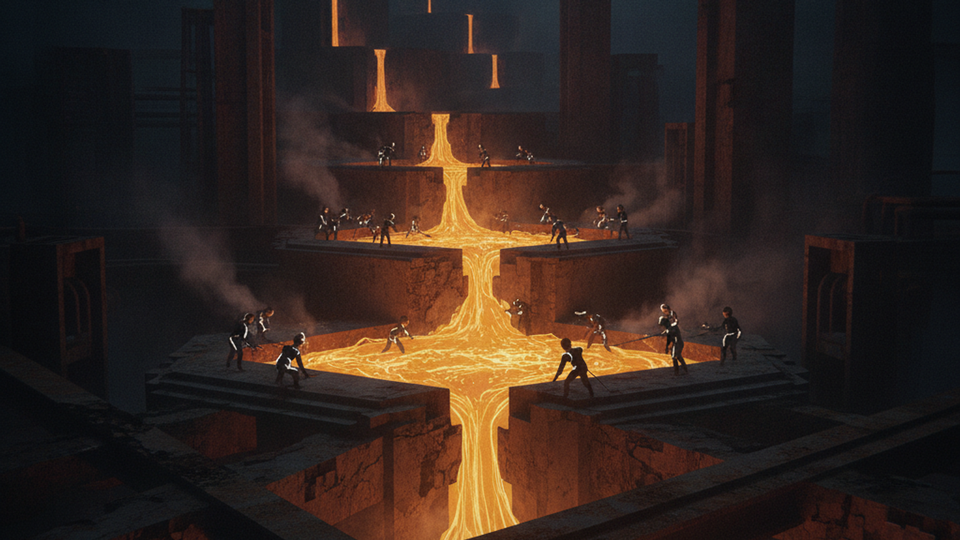
While white-collar workers worry about AI taking their jobs, electricians and welders are getting hired faster than anyone can train them.
The Summary
- AI data center construction is becoming the largest capital expenditure project in US history, outpacing the buildout of highways and railroads as a share of GDP
- Nonresidential specialty trade contractors grew by 86,000 workers in the past year, driven almost entirely by data center demand
- Overall construction spending is down year-over-year, but data center spending is skyrocketing — creating a two-tier labor market in the trades
The Signal
The infrastructure powering Web4 isn't virtual. It's concrete, steel, copper wire, and cooling systems the size of football fields. The Brookings Institution pegged AI buildouts as the biggest capex project in American history, larger than the Interstate Highway System or transcontinental railroads when measured as GDP share. That's not hype. That's millions of square feet of server farms going up across Nevada, Texas, and the industrial Midwest.
The labor demand is specific and intense. We're not talking general construction workers. We're talking electricians, HVAC specialists, and high-voltage technicians who can wire the kind of power infrastructure that keeps thousands of GPUs from melting. These aren't jobs you can offshore or automate with an agent. You need hands that know how to pull cable in a live data hall without killing yourself.
"A very large portion of construction labor demand right now is being driven by increasing data center construction activity."
Here's the split that matters: overall construction spending fell year-over-year while data center work exploded. Housing starts are soft. Commercial real estate is still figuring out what to do with empty office towers. But if you're a licensed electrician willing to work data center jobs, you're fielding multiple offers. The American Institute of Architects is tracking this as a structural shift, not a cycle.
The 86,000 new trade contractor jobs in the past year represent more than raw headcount. They're a bet that AI compute will keep scaling, that the agent economy needs physical substrate, and that no amount of algorithmic efficiency will eliminate the need for more racks, more cooling, more power. Zach Fritz at Associated Builders and Contractors isn't mincing words: data centers are driving the bulk of construction labor demand right now.
Key tensions:
- Training pipeline: Trade schools aren't graduating electricians fast enough to meet demand
- Geographic concentration: Data centers cluster near cheap power and fiber, leaving other regions behind
- Wage pressure: Specialized data center work pays better than standard commercial electrical, creating internal labor market competition
The Implication
If you're advising someone on career paths, the irony is thick: the same AI that threatens knowledge work is creating blue-collar opportunity at scale. Trade certifications with data center specialization are becoming golden tickets. Electricians who understand high-density power distribution, techs who can commission cooling systems for AI clusters — these aren't fungible skills.
For companies building in this space, labor availability is now a primary site selection factor alongside power costs. The places that invested in vocational training infrastructure five years ago are winning data center projects today. The rest are scrambling to import skilled labor or watching projects delay. The physical world still has physics, and physics requires people who know how to build things.