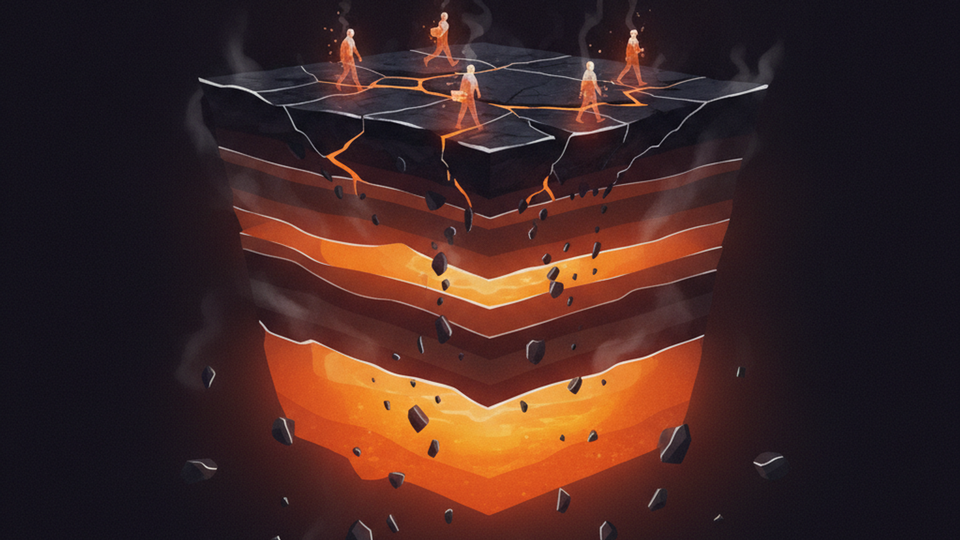
Google's public AI releases are already obsolete by the time you read the blog post.
The Summary
- Google employees are testing Gemini 4 "Carbon", an internal build that staff say matches Anthropic's Opus 5.5 for coding, while the company prepares to release the earlier "Argon" version to the public
- The gap between what Google ships and what Google has tells you everything about the AI model release cadence wars
- If you're building on any of these models, you're building on a moving target that's already two checkpoints behind
The Signal
Google is about to release Gemini 4 Argon. Inside Google, engineers are already calling it old news. They're testing Carbon, a newer checkpoint that one employee compared to Anthropic's Opus 5.5 for long-term agentic coding work. The comparison matters because Anthropic and OpenAI have pulled ahead among developers building complex engineering agents.
This is how model releases work now. By the time a company announces a model, ships it, and you start building on it, the internal teams are already three versions ahead. Google has tested at least three Gemini 4 variants: Argon, Barium, and Carbon. The naming convention follows chemistry's periodic table, which is charmingly nerdy but also reveals the assembly line approach to model iteration.
"Carbon feels like Opus 5.5 for coding, but I'd need to test it more."
Early Argon builds got mixed reviews internally. One employee said it lagged behind on some coding tasks compared to Claude Opus 5, an older Anthropic release. That's a problem when you're Google trying to catch up in the coding agent race. The fact that Carbon might close that gap doesn't mean users will see it. Google isn't guaranteed to release every internal checkpoint. Some models get shelved. Some get cannibalized for parts. Some become the foundation for the next public release six months later.
Here's what this means for anyone building AI-powered products:
The model you're using is not the model they have. The gap between internal testing and public release is growing, not shrinking. Companies like Google, Anthropic, and OpenAI are running continuous training pipelines. Every week brings new checkpoints. Every checkpoint gets evaluated. The best ones become candidates for release. The rest inform the next training run.
Coding agents are the new battleground. Not chatbots. Not image generation. Not summarization. The models that can write, debug, and maintain complex codebases over multiple sessions are where the competitive advantage lives. That's where Anthropic has been winning with Opus 5.5. That's where Google is scrambling to catch up.
Internal tooling is the real product. Google employees test these models on Jetski, their internal coding platform. That integration matters more than any API release. The companies building the best internal AI tools for their own engineers are also building the blueprint for what external developer tools become later. Watch where the internal deployments go. External products follow.
The Implication
If you're betting your product roadmap on a specific model's capabilities, build in more flexibility than you think you need. The ground is moving faster than release notes suggest. The model that's state-of-the-art today will be outclassed by an internal checkpoint tomorrow and publicly obsolete in three months.
For developers, this is actually good news. The pace of improvement means the tools keep getting better. But it also means you need to design systems that can swap models without rewriting your entire stack. Anthropic has the coding agent lead today. Google might close it with Carbon. Someone else might leapfrog both by the time you read this. Build for that reality.