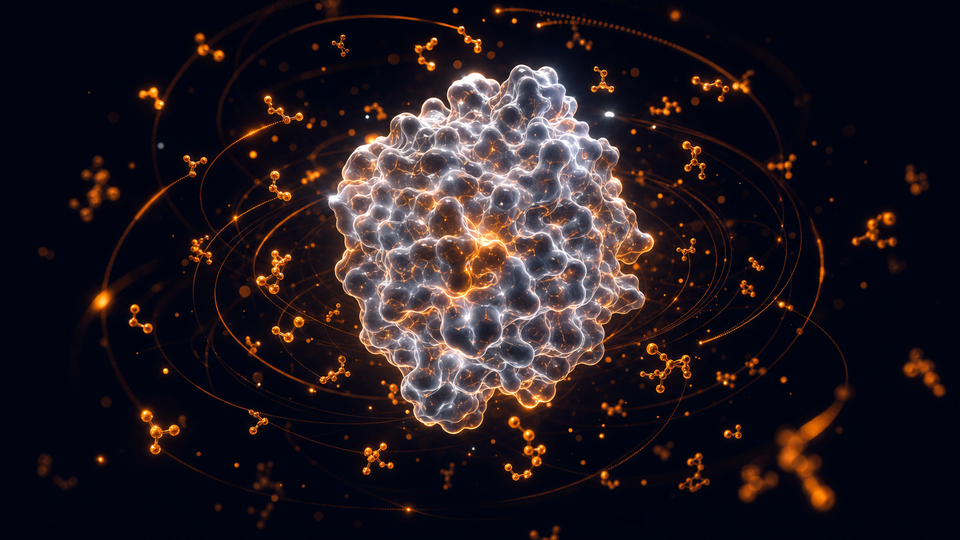
AlphaFold won a Nobel for predicting protein shapes, but turns out knowing what a protein looks like doesn't tell you where to stick a drug into it.
The Summary
- Isomorphic Labs, the Google DeepMind spinoff, raised $2.1 billion and published details on its Drug Design Engine, a system that finds binding pockets on proteins and predicts molecular interactions
- The company has secured drug-discovery partnerships with Novartis and Eli Lilly, moving beyond AlphaFold's structure prediction into actual molecule design
- Despite a decade of hype and billions invested, few AI-designed medicines have reached patients because drug testing timelines can't be compressed and development remains brutally difficult
- AlphaFold solved protein folding but couldn't predict how proteins interact with other molecules, the critical step for drug design
The Signal
Isomorphic Labs is building on Nobel Prize-winning technology that everyone thought would revolutionize drug discovery three years ago. Except it didn't. AlphaFold2 could tell you the three-dimensional shape of a protein with stunning accuracy, but proteins don't just sit there looking pretty. They bind to other proteins, to small molecules, to the drugs we're trying to design. Knowing the shape is like having a detailed map of a building but no idea where the doors are.
The Drug Design Engine tackles the door problem. It predicts binding pockets, the specific spots on a protein where a drug molecule can latch on and do its work. More importantly, it models the interactions between proteins and potential drug candidates, the molecular dance that determines whether a compound will work or wash out in clinical trials.
"Proteins don't exist in a vacuum. They interact with a wide variety of other molecules."
Here's what makes this more than vaporware: Novartis and Eli Lilly don't write checks to spinoffs playing with interesting models. They pay for technology that might actually put drugs into humans. The $2.1 billion funding round suggests other investors agree. That's real money betting on a company that published its technical approach in February, making its methodology visible to scrutiny.
The gap between AlphaFold's success and practical drug design reveals why AI in biotech has been slower than the hype cycle predicted. Structure prediction was a well-defined problem with clear success metrics: predict this shape, check it against experimental data, measure accuracy. Drug design is messier. You need to predict interactions, account for how molecules move and flex, understand what happens when a potential drug meets not just one protein but a whole biological system.
The Implication
Watch how fast Isomorphic moves compounds through early testing. If their AI actually improves hit rates in preclinical work, the pharma partnerships will expand and the model will spread. If it doesn't, this becomes another example of AI solving the academic problem while missing the applied one. The technical report matters because it invites replication and competition, which means we'll know within two years whether this approach works at scale.
For anyone building AI agents in other domains, the lesson is structural: prediction models that work in controlled settings often fail when the system gets complex and the success criteria get fuzzy. Isomorphic's bet is that they can handle the complexity. The pharma giants' bet is that they're right.