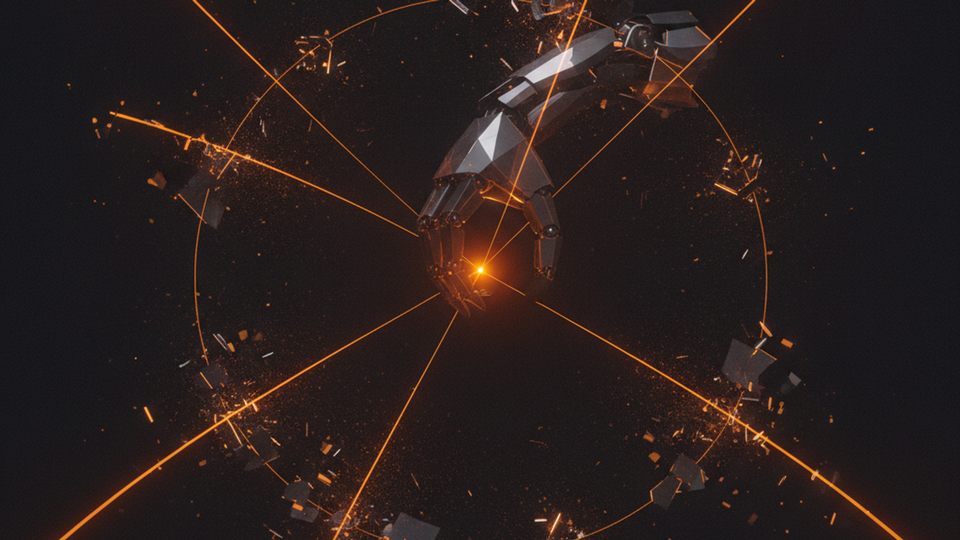
The robots that don't drop things are teaching AI agents how to not burn down your business.
The Summary
- Industrial AI is moving beyond predictive analytics into physical automation that can interact with real-world systems, raising the stakes for reliability.
- Standard Bots builds AI that learns factory tasks from human demonstrations and improves through corrections from actual production deployments.
- The core insight: when AI controls physical systems, the learning loop has to include real-world consequences, not just simulation.
- Factory floors are becoming the proving ground for agentic AI reliability that will eventually matter everywhere else.
The Signal
Industrial robotics spent decades learning one lesson that consumer AI is just now confronting: when your software controls something physical, perfect is the only acceptable failure rate. Foundation models and agentic AI are making complex industrial automation possible, but the difference between a chatbot hallucinating and a robot arm miscalculating is the difference between embarrassment and injury.
Standard Bots' approach centers on pretrained models that learn from demonstration, then get corrected by what actually happens in deployment. This is the opposite of how most AI gets built. Consumer AI ships fast, breaks things, patches later. Factory AI has to work the first time, every time, because the feedback loop includes broken parts, damaged products, and potentially hurt workers.
"Industrial AI can interact directly with physical systems, raising stakes beyond pure digital applications."
The technical architecture matters here. Standard Bots isn't just wrapping an LLM around a robot arm. They're building:
- Vision systems that understand 3D factory environments in real time
- Learning loops that incorporate corrections from actual production runs
- Models pretrained on industrial tasks, not scraped internet text
The shift from specialized predictive analytics to general-purpose physical automation represents a phase change in what industrial AI can do. Previous generation systems could predict when a machine would fail. This generation can operate the machine, adjust to variations in materials or positioning, and learn new tasks without full reprogramming.
The learning-from-demonstration approach solves a real problem. You can't hire enough ML engineers to hand-code every factory task. But you can have experienced operators show the system what to do, then let it practice under supervision. The AI gets better by doing the actual work, with real parts, in real conditions. No sim-to-real gap, no hoping the digital twin matched reality.
This matters beyond factories. Every agentic AI system that will eventually touch the physical world, from delivery robots to infrastructure maintenance to surgical assistants, will need this kind of reliability-first architecture. The companies building AI agents for knowledge work think they're playing a different game, but they're not. When your AI agent starts booking flights, moving money, or filing legal documents, the consequences of mistakes become physical fast.
The Implication
If you're building AI agents, watch what works in industrial robotics. The reliability patterns, the learning loops that include real-world correction, the insistence on safety margins that consumer AI treats as optional. These aren't constraints that slow you down. They're the foundation that lets you scale without breaking things that matter.
For everyone else: the factories getting automated right now are the test bed for the agents that will eventually run more of everything. The ones that work will be the ones that learned to be reliable when reliability actually mattered.