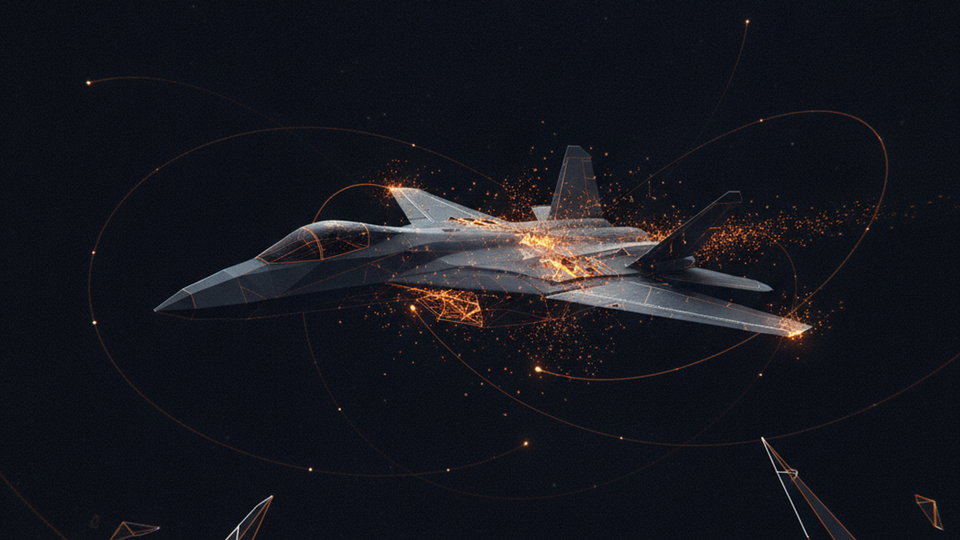
The world's most expensive weapons program just hired ChatGPT's parent company to fix its math homework.
The Summary
- Lockheed Martin is deploying 55 different LLMs across its operations, with OpenAI specifically embedded with the F-35 team to solve "complex math and physics challenges" related to advanced sensors
- The defense giant is treating AI models like commodities—test rigorously, deploy what works, stay model-agnostic
- Applications span from back-office optimization to autonomous weapons and crewed-uncrewed teaming, signaling the military-industrial complex is building for an agent-heavy future
The Signal
Lockheed Martin's SVP of Technology just casually mentioned that OpenAI is sitting inside the F-35 program. Not consulting. Not advising. Working alongside the team on sensor physics and advanced math. This is the defense industrial base absorbing AI infrastructure at the component level, the same way it once absorbed GPS and stealth coating.
The F-35 is a $1.7 trillion program across its lifetime, the most complex weapons system ever built, equipped with sensor arrays that generate more data per flight hour than most tech companies process in a day. The fact that Lockheed brought in OpenAI specifically for the math problems means the sensor fusion challenges aren't just engineering-hard, they're computationally novel.
"55 different large language models across its business" means Lockheed is treating AI like an assembly line, not a science project.
The model-agnostic strategy tells you everything. Lockheed isn't betting on one AI lab or building proprietary foundation models. They're treating LLMs the way they treat fasteners: spec them, test them, use what fits. Sarah Hiza's framing around testing before deployment isn't PR fluff, it's how you operate when model failure could mean a $100 million aircraft spiraling into the South China Sea.
The real story is the crewed-uncrewed teaming mention. Lockheed has been flying loyal wingman drones for years, but the integration of commercial AI infrastructure into those systems marks a shift. The military isn't just using AI for intelligence analysis or logistics anymore. It's embedding it into kinetic operations, decision loops, and autonomous weapons platforms.
Key developments in the agent-weapons pipeline:
- OpenAI now has access to defense-grade R&D problems, accelerating their model capabilities in physics simulation and sensor processing
- Lockheed's 55-model ecosystem creates a template for how other defense primes will absorb AI, favoring interoperability over vendor lock-in
- Crewed-uncrewed teaming becomes the forcing function for real-time multi-agent coordination under adversarial conditions
This isn't about making the F-35 slightly better. It's about what happens when the companies building frontier AI get direct feedback loops from the most resource-intensive engineering programs on Earth. OpenAI learns from problems Google Cloud will never see. Lockheed gets access to inference capabilities that were science fiction three years ago.
The Implication
The defense sector just became the private sector's best AI training ground. If you're building agent infrastructure, watch where Lockheed's 55 models succeed and fail. Multi-model orchestration under high-stakes conditions is the blueprint for every other industry trying to deploy agents at scale.
The F-35 partnership also signals that OpenAI's competitive moat isn't just model performance anymore. It's access to the hardest unsolved problems in applied physics and engineering. When your models train on sensor fusion math that stumps Lockheed's internal teams, you're not just building a chatbot company.