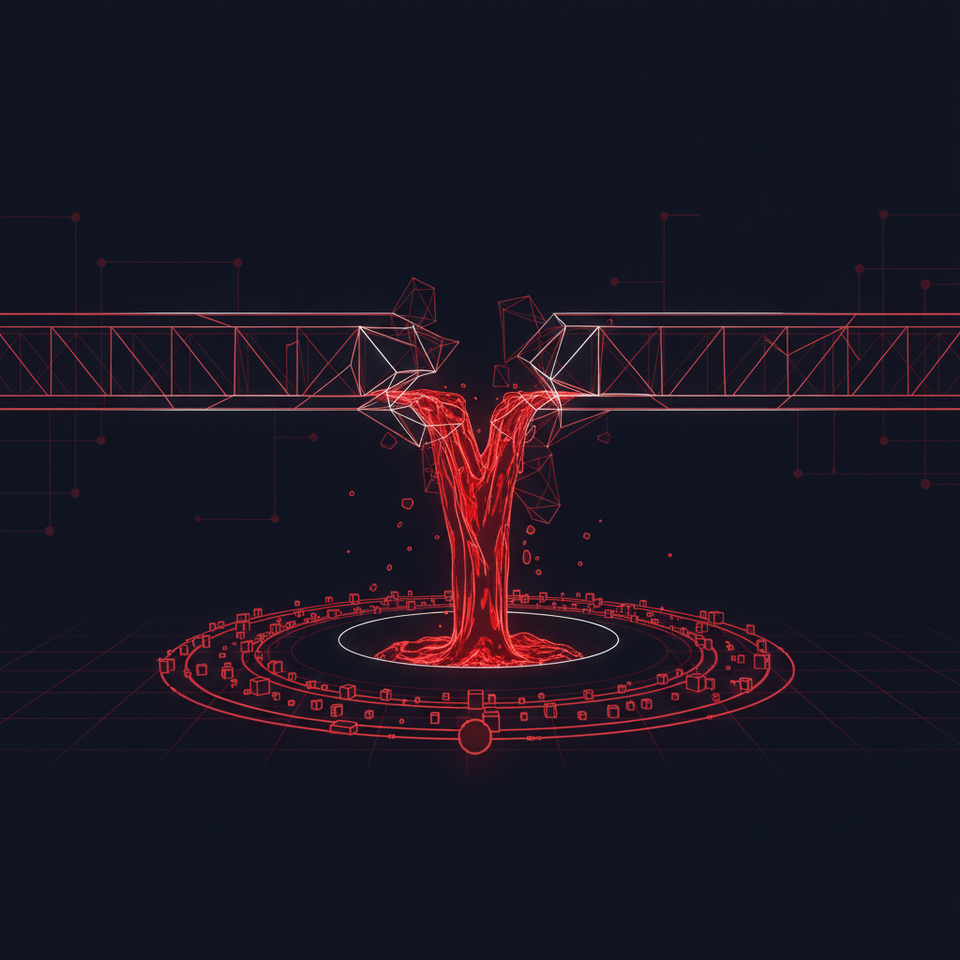
A nation-state just walked off with $292 million through a DeFi bridge, triggered $10 billion in panic withdrawals, and forced a Layer 2 to freeze assets for the first time in its history.
The Summary
- North Korea-linked hackers exploited Kelp DAO's rsETH bridge for $292 million in a LayerZero-based attack, part of $578 million in DPRK-linked crypto theft in April alone
- Aave faces $124-230 million in bad debt depending on how Kelp socializes losses, triggering $10 billion in user withdrawals
- Arbitrum's Security Council froze $71 million in stolen ETH, the first time a major Layer 2 has exercised this nuclear option
- Bridges remain crypto's weakest link, with structural vulnerabilities in shared infrastructure and hidden trust assumptions
- AAVE token dropped 12% as DeFi's interconnected risk became brutally visible
The Signal
Kelp DAO's emergency multisig froze core contracts 46 minutes after the drain, blocking two follow-up attempts. Too late. The attackers had already minted fake rsETH tokens through a bridge vulnerability and drained real ETH collateral. This wasn't a novel attack vector. It was the same pattern that's bled billions from crypto: complex cross-chain systems with trust assumptions nobody fully mapped until money went missing.
What makes this different is the cascade. Kelp's rsETH was collateral across DeFi, with the biggest exposure on Aave. An incident report from Aave Labs and LlamaRisk laid out two scenarios for socializing losses. The cheap option concentrates pain at Layer 2 level but risks a 15% rsETH depeg. The expensive option protects Ethereum mainnet but pushes bad debt higher.
"The problem is structural and as long as bridges depend on complex systems with shared infrastructure and hidden trust assumptions, they will remain vulnerable."
Users didn't wait for the math. $10 billion fled Aave as depositors realized their yield-bearing stablecoin positions sat downstream from nation-state hackers. This is the real contagion risk in DeFi: not the exploit itself, but the moment everyone realizes the collateral graph connects everything to everything else. You deposit USDC to earn 4%. Three hops away, that liquidity backs someone borrowing against a token that just got nuked.
Then Arbitrum did something unprecedented. The Security Council moved 30,766 ETH ($71 million) to a frozen intermediary wallet, accessible only via further governance action. Griff Green explained this was about stopping North Korea from funding weapons programs, not setting precedent for routine intervention. But precedents don't care about intentions.
Key context on the attacker:
- April 2026 alone: $578 million in DPRK-linked theft
- Attacks expanding across protocols, companies, end users
- Direct funding pipeline for weapons development
This marks the first time a major Layer 2 froze assets post-exploit. Arbitrum has a Security Council for exactly this type of emergency, but using it reveals the trade-off crypto pretends doesn't exist. You can have a credibly neutral base layer, or you can have a coordinated response to nation-state theft. Pick one.
The Implication
Every bridge is a bet that the trust assumptions holding it together are actually mapped and bulletproof. Most aren't. Until cross-chain infrastructure solves the complexity problem, expect more of this. The DPRK money shows why: half a billion in one month means the incentive to keep probing these systems just went exponential.
For DeFi users, the Aave withdrawals show what institutional risk modeling looks like in real time. When collateral becomes suspect, you don't wait for the DAO to vote on loss allocation. You leave. For developers, the Arbitrum freeze is the warning shot. Security Councils exist, and they will act. Build like someone might reach in and stop your contracts mid-execution, because now we know they can.
Sources
Coinage | RWA Times | CoinDesk | CoinTelegraph | Crypto Briefing | Unchained Crypto | The Block