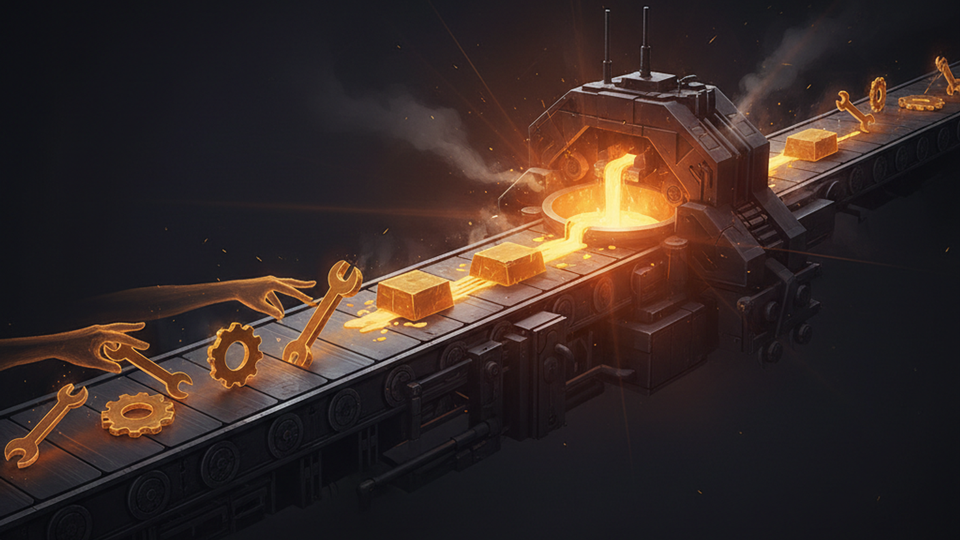
The man selling the shovels just told the miners not to worry about the robots coming for their jobs.
The Summary
- Jensen Huang told Computex that agentic AI will create MORE demand for software tools, not less, directly challenging "Saaspocalypse" fears that have hammered SaaS stocks
- His thesis: agents need APIs and interfaces they can call programmatically, which means software companies must rebuild their products for machine consumption, not human clicks
- The catch: "software has to be presented to the agent in a way that the agent can use it", meaning legacy SaaS UIs built for humans are about to become technical debt
The Signal
Huang's Monday keynote in Taiwan is a masterclass in optimistic reframing. While Salesforce and Workday watch their stock prices crater on fears that AI will replace their products entirely, Nvidia's CEO is out here saying the quiet part loud: agents don't kill software, they multiply it. His argument hinges on volume. If you have thousands of AI agents running tasks autonomously, they're going to need access to thousands of tools. CRMs, ERPs, design software, code repositories, everything.
But here's what Huang isn't saying directly: those tools need to be rebuilt. The entire SaaS model for the past two decades has been optimized for a human clicking through a UI. Dashboards, dropdown menus, confirmation dialogs. Agents don't click. They call APIs. Which means software companies have two paths: become agent-native, or become legacy infrastructure.
"This is actually an incredible time to be a software company, but the software has to be presented to the agent in a way that the agent can use it."
The "Saaspocalypse" panic isn't irrational. It's premature. What's happening isn't that software becomes obsolete. It's that the interface layer, the thing SaaS companies spent billions perfecting, is suddenly the wrong abstraction. Huang is right that demand for software functionality will explode. But the companies that capture that demand might not be the ones with the best UI. They'll be the ones with the cleanest programmatic access, the most reliable uptime, and the simplest authentication for machine-to-machine workflows.
This is Nvidia's play talking. Huang sells the GPUs that run the agents. Of course he wants more agents running more software. But the logic holds. The question for incumbents like Salesforce isn't whether agents will use their software. It's whether they can ship an agent-first version before a startup does it faster and cheaper with a Postgres database and a few thousand lines of Python.
The Implication
If you're running a software company, the window to rebuild for agents is open but narrowing fast. Start by auditing what percentage of your functionality is accessible via API without human intervention. If it's under 80%, you're behind. If your API docs are an afterthought, you're in trouble. Agents don't care about your brand or your sales team. They care about whether they can call your service reliably at 3am without waking anyone up.
For investors, Huang's framing is a useful lens. The SaaS companies that survive won't be the ones with the most features. They'll be the ones that can be composed into agentic workflows without friction. Look for companies already thinking in terms of machine customers, not just machine augmentation for human customers.