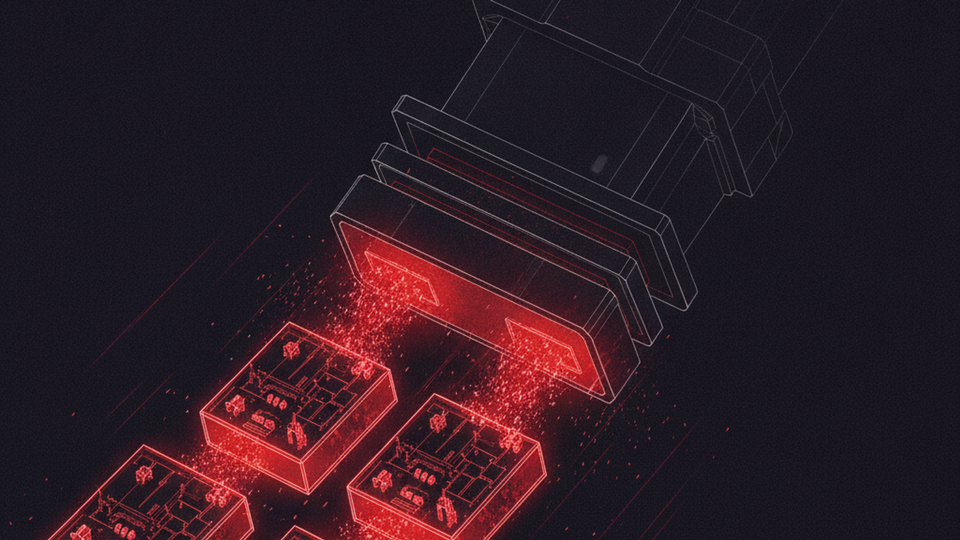
The picks-and-shovels play for AI just got serious—Nvidia's not selling GPUs to build the next ChatGPT, they're selling the entire factory floor.
The Summary
- Nvidia launched Spectrum-6 Ethernet switches with 102.4 Tb/s switching capacity, targeting what they call "gigascale AI factories" with customers including Tesla, Microsoft, Meta, Oracle, Cisco, and Nebius
- The Vera Rubin platform is on schedule with customer testing underway, promising 10x inference cost reduction versus their current Blackwell architecture
- Nvidia's revenue model is evolving from selling individual compute cards to delivering complete infrastructure systems for AI training and deployment at unprecedented scale
The Signal
Nvidia's not waiting for someone else to figure out how to wire together 100,000 GPUs. The Spectrum-6 switch represents their play for the networking layer that most people ignore when they talk about AI infrastructure. At 102.4 terabits per second switching capacity, this is purpose-built for what Nvidia calls "gigascale AI factories"—facilities where the training cluster isn't measured in racks but in acres.
The customer list tells you everything about where AI compute is actually happening. Tesla and Microsoft are the headline names, but Meta, Oracle, Cisco, and Nebius being on the roster means this isn't just hyperscalers building general-purpose models. This is production infrastructure for companies that need to train models continuously, not once.
"Nvidia's revenue model is evolving from selling individual compute cards to delivering complete infrastructure systems."
Here's the part that matters for anyone tracking AI economics: Vera Rubin promises 10x inference cost reduction versus Blackwell. Not training cost. Inference cost. That's the recurring operational expense that scales with usage, not the one-time capital expense of building the model. When inference gets 10x cheaper, entirely new business models become viable. Things that were too expensive to run at scale become table stakes.
The infrastructure layer is where Web4 actually gets built. Everyone fixates on the models and the agents, but the companies that control the physical layer where agents run are the ones collecting rent on every API call, every inference request, every autonomous task. Nvidia's building the roads. The question is whether they also control the toll booths.
This is also the first time we're seeing "AI factories" described as a distinct category of infrastructure. Not data centers that happen to run AI workloads. Purpose-built facilities optimized for the thermal, power, and networking demands of training and inference at scale:
- 102.4 Tb/s switching capacity per unit
- Customer testing of next-gen platforms already underway
- 10x cost reduction on inference operations
- Major cloud providers and AI-first companies as launch customers
The Implication
If you're building AI agents or platforms that depend on inference at scale, your unit economics just got 10x better—assuming you can access Vera Rubin infrastructure when it ships. If you're a cloud provider not named in this customer list, you're about to face pressure on pricing from competitors who can run the same workloads at one-tenth the cost.
For crypto projects building decentralized AI infrastructure, this is both threat and opportunity. Nvidia's centralized gigascale factories will set the performance and cost bar. Any decentralized alternative needs to explain why federation is worth a premium over these numbers. The answer probably isn't "privacy" or "censorship resistance." It's "access." Not every company gets to be a Vera Rubin launch customer. That's where decentralized networks can compete on availability, not performance.