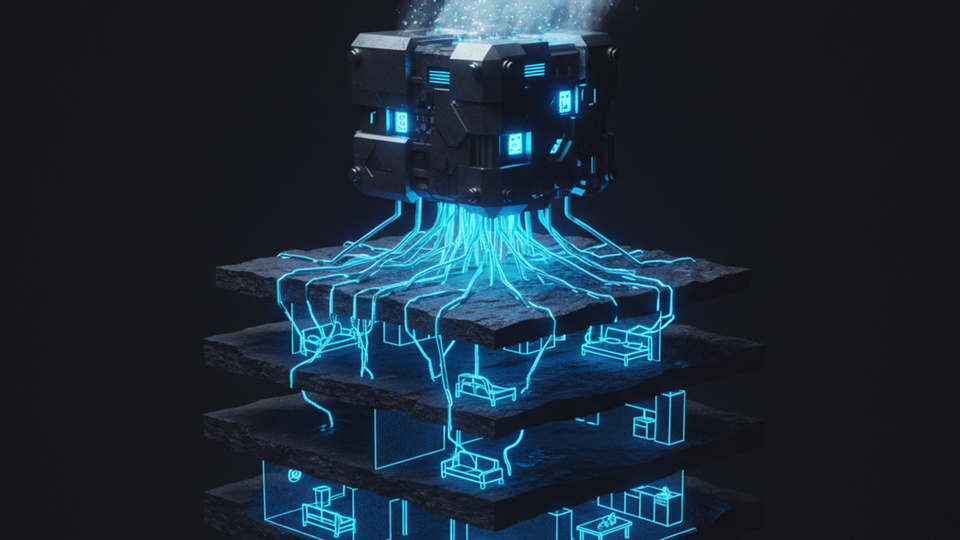
Nvidia just bet on turning suburban garages into AI infrastructure—and if you think *you're* the customer, you haven't looked at your electric bill lately.
The Summary
- Nvidia is backing Span, a California startup putting GPU nodes that look like HVAC units next to homes, routing "unused" household electricity to 16-GPU boxes for distributed AI compute
- The pitch: homes use only 42% of allocated power on average, so why not monetize the headroom while Span pays your electric and internet bills
- The reality: zero real-world deployments yet, only internal modeling, and a partnership with one homebuilder to test at new construction sites
The Signal
The grid can't keep up with AI's appetite. That's not speculation anymore, it's the constraint. Data center developers have money and chips but can't get the power hookups fast enough. So Span is proposing a workaround: don't build new capacity, colonize existing residential allocations. Each node packs 16 Nvidia GPUs, 4 AMD CPUs, and 4TB of memory into a box that sits outside your house like an AC unit. When your dishwasher isn't running and your EV isn't charging, Span's smart utility box detects the slack and routes power to the GPUs instead.
Distributed compute for AI workloads is theoretically elegant. You get lower latency by putting processing closer to end users. You skip the years-long permitting nightmare of building hyperscale facilities. You turn homeowners into infrastructure partners and pay them in reduced utility bills. On paper, it's a grid hack that turns suburban sprawl into an asset.
"We've done a bunch of technical studies internally and a bunch of modeling for different kinds of workloads."
But here's what Span VP Chris Lander actually said when asked if this works for real AI jobs: they've modeled it. Internally. They haven't proven that connecting hundreds or thousands of home nodes can handle production inference workloads without latency spikes, thermal throttling, or network bottlenecks. They haven't shown that residential internet uplinks can sustain the bandwidth. They haven't deployed a single unit at an actual home yet. They're partnering with Atlanta homebuilder Pulte Homes to test at new construction sites, which means the earliest real-world data is months away, best case.
The risks stack up fast:
- Homeowners become the weakest link in AI infrastructure reliability—what happens when someone trips a breaker or their router dies?
- Residential power grids weren't designed for sustained compute loads; transformer failures could cascade across neighborhoods
- Who owns liability when a GPU node catches fire, melts siding, or draws enough power to dim the lights three houses down?
This isn't Web4. It's a financial instrument disguised as a technology play. Span gets distributed infrastructure without building data centers. Nvidia gets another channel for GPU sales. Homebuilders get a marketing angle for "AI-ready homes." And homeowners get a discount on their electric bill in exchange for becoming unpaid data center operators with hardware depreciation risk, fire insurance questions, and zero control over what compute jobs run on their property.
The edge cases multiply. What happens when AI demand spikes and your node pulls power while you're trying to charge your car and run the AC during a heat wave? Span says the smart box handles prioritization, but those algorithms haven't been stress-tested at scale. What happens when the workload you're hosting trains a model you find objectionable, or when law enforcement wants access to logs from the hardware sitting in your yard?
The Implication
If you're a homeowner and Span comes knocking, read the contract like you're leasing your property to a stranger. You're not getting free money, you're trading property rights and electrical capacity for a subsidy. Ask who owns the hardware, who's liable for damage, and whether you can opt out once the node is installed.
If you're building Web4 infrastructure, watch this experiment closely. Distributed residential compute could work for lightweight inference or edge caching, but it's not replacing hyperscale data centers for training or high-stakes workloads anytime soon. The physics and liability questions are real. The fact that Nvidia is involved doesn't mean the model is proven, it means Nvidia wants more GPU deployment channels while the grid buildout lags.
The grid constraint is the story. Everything else is just people trying to arbitrage it.