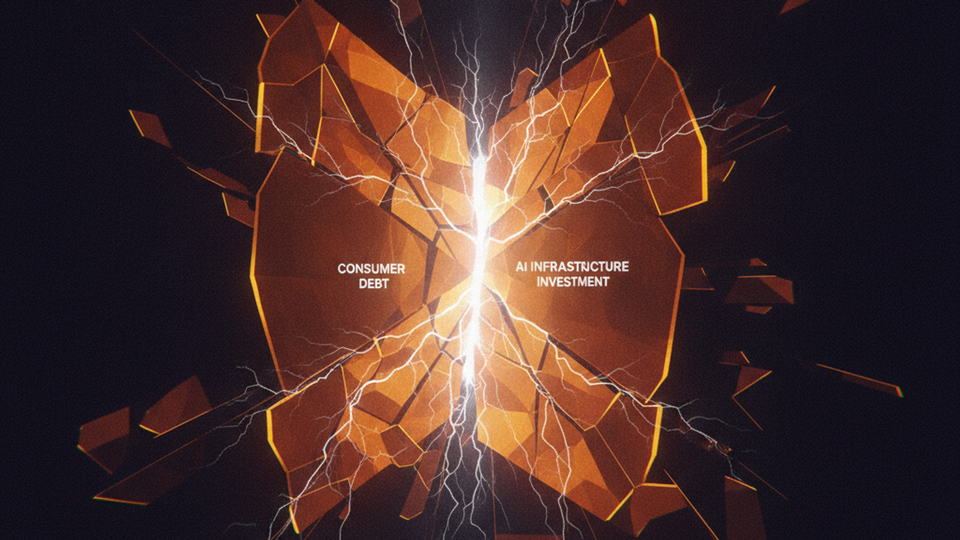
When a banking analyst starts connecting Nvidia's stumble to consumer credit risk, something fundamental is breaking in the AI investment thesis.
The Summary
- Meredith Whitney warns of a collision between consumer financial stress and weakening AI infrastructure demand, citing tight lending, delayed data centers, and questions about chip order sustainability
- Nvidia's selloff signals potential overcapacity in AI hardware as "circular financing" props up demand that may not reflect real end-user adoption
- If AI infrastructure investments slow while consumer spending deteriorates, banks holding exposure to both sides face compounding risk
The Signal
Meredith Whitney made her name calling the 2008 financial crisis before most people saw it coming. Now she's drawing lines between Nvidia's recent selloff and deteriorating consumer fundamentals, and the connection isn't obvious until you follow the money. When housing and food costs stay elevated while lending standards tighten, consumers pull back. That much is Economics 101.
What's new is how that consumer weakness intersects with the AI infrastructure buildout. Whitney points to delayed data centers and questions about whether chip demand is real or manufactured through what she calls "circular financing." Translation: companies borrowing to buy GPUs to build capabilities they hope will generate returns someday, funded by lenders who believe the AI story because everyone else does.
"Circular financing in chip demand means someone's holding a bag when the music stops."
Here's the mechanical problem. Big Tech and cloud providers have been ordering chips at a pace that assumes exponential growth in AI workloads. But actual revenue-generating AI applications remain thin on the ground. Most enterprise AI deployments are still pilot programs or proof-of-concepts. Consumer AI products beyond chatbots haven't found product-market fit at scale. Meanwhile, those data centers Whitney mentions are getting delayed, which means the infrastructure to actually use all those chips is lagging the chip orders themselves.
Banks sit at the intersection of both problems. They're lending to consumers who are increasingly stretched. They're also financing the AI buildout through credit lines to startups, construction loans for data centers, and exposure to tech company debt. If consumer defaults rise while AI investments fail to generate promised returns, banks get hit twice. Whitney's warning is that these aren't separate risks but connected ones, and the connection runs through overleveraged balance sheets on both sides.
Key pressure points building:
- Consumer credit metrics deteriorating as inflation stays sticky in essentials
- AI infrastructure investments outpacing actual workload growth by estimated 3-5x
- Bank exposure to both consumer debt and tech sector financing creating correlated risk
The Nvidia selloff matters because it's the first crack in the narrative that AI demand is infinite and inevitable. Chip orders are forward-looking bets. When those bets start getting repriced, it means someone ran the numbers and didn't like what they saw. If data centers are getting delayed, it's because the business case for building them right now, at current costs, with current demand projections, stopped penciling out.
The Implication
Watch credit default swap spreads on banks with heavy tech sector exposure and consumer lending books. If Whitney's thesis plays out, the warning signs will show up there first. For companies building in the agent economy, this means the cost of capital for AI infrastructure could spike just as the technology starts getting useful. The gap between "AI is overhyped" and "AI is transformative" might be a financing crisis, not a technology problem.
The real question isn't whether AI works. It's whether the financial structure supporting the buildout can survive long enough for the economics to catch up to the investment. If banks start pulling back on both consumer and tech lending simultaneously, we find out the hard way.