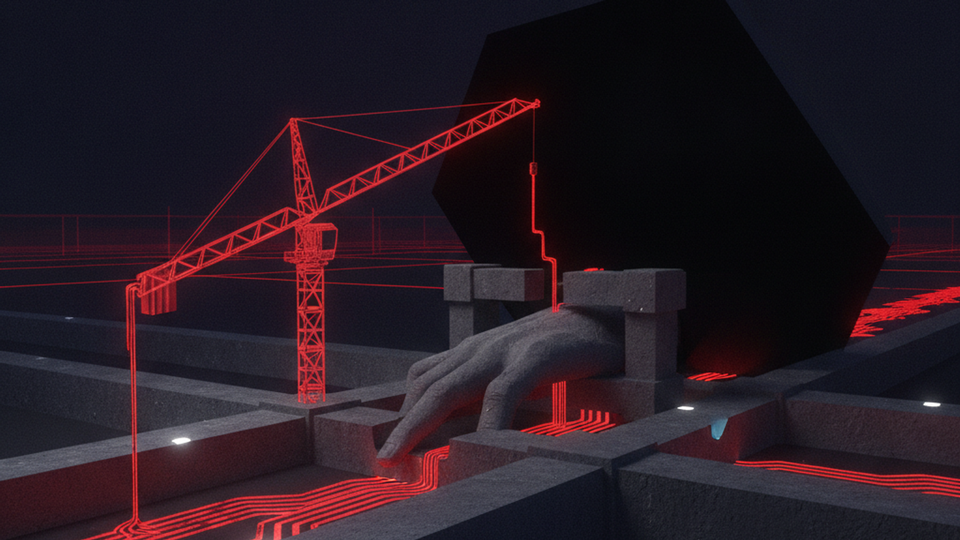
When the world's most valuable chipmaker starts personally managing construction timelines, you're watching infrastructure become the new bottleneck in the AI race.
The Summary
- Nvidia CEO Jensen Huang is personally pushing Nscale to accelerate data center construction, signaling that infrastructure delays are now a board-level crisis for AI companies
- TD Cowen reports Nvidia may guarantee Oracle's data center leases or sublease capacity to help secure construction financing, an unprecedented move for a chip company
- Nvidia partnered with Infineon on 800V power conversion systems for AI data centers, addressing the energy infrastructure gap that's quietly strangling GPU deployments
- The pattern: Nvidia is moving backward in the value chain because forward momentum has stalled at the foundation level
The Signal
Nvidia has the chips. It has the demand. What it doesn't have is enough buildings to put them in, fast enough. Jensen Huang's direct intervention with Nscale on construction timelines is the clearest signal yet that data center infrastructure, not silicon innovation, is now the limiting factor in AI deployment. When a CEO known for product launches starts managing construction schedules, the bottleneck has moved.
The TD Cowen report on Oracle adds texture: Nvidia is considering financial backstops, lease guarantees, or subleasing capacity to help Oracle secure construction financing. This is not normal chipmaker behavior. Intel never guaranteed Dell's warehouse leases. This is vertical integration born of desperation, or at least impatience.
"When your customer can't build fast enough, you either wait or you write checks. Nvidia is writing checks."
The numbers make it clear why. AI training clusters now pull 10-50 megawatts per building. Inference deployments at scale need hundreds of thousands of square feet with power density legacy data centers never planned for. Construction timelines that used to be 18-24 months are being asked to compress to 12. Permitting, power grid connections, cooling systems—all designed for a different era. Nvidia's chips are ready. The concrete isn't.
Key infrastructure gaps Nvidia is now solving:
- Physical construction speed (Nscale)
- Construction financing risk (Oracle backstop)
- Power conversion efficiency (Infineon 800V partnership)
The Infineon partnership fills in the third piece. 800V power systems are more efficient than the 400V standard most data centers run today. Less heat, less copper, less space. Infineon brings automotive-grade power conversion tech, battle-tested in EVs, to racks of H100s. This matters because energy infrastructure is just as constrained as physical infrastructure. You can't plug a 20-megawatt AI cluster into a grid designed for 5 megawatts without months of utility company coordination.
What's happening is a coordination failure between the pace of AI progress and the pace of commercial real estate and electrical engineering. Software compounds exponentially. Construction compounds linearly, at best. Nvidia is now in the business of trying to compress linear timelines to keep pace with exponential demand.
The Implication
If you're building AI infrastructure or investing in it, watch where Nvidia is putting its weight. The company is signaling loud and clear: the edge is in logistics, not just chips. Construction speed, power conversion, financing structures—these are now competitive moats. Whoever can build and power data centers fastest will deploy models fastest, which means they'll capture users fastest.
For tokenization and Web3, this has a second-order effect. Decentralized compute networks like Render or Akash promise to route around centralized infrastructure bottlenecks. But they still need physical data centers to exist. If Nvidia is now de facto financing construction to ensure supply, that's a vote of no confidence in the market's ability to build fast enough on its own. It also means centralized players with Nvidia's backing may pull further ahead, making the decentralized compute thesis harder, not easier.