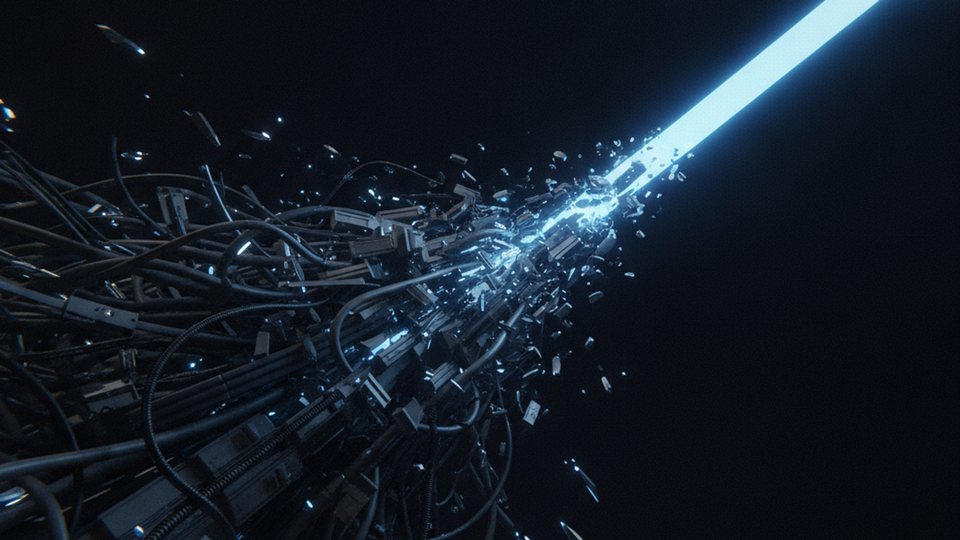
Nvidia just made the industrial guts of AI infrastructure look like consumer electronics—and that aesthetic shift signals something bigger about who gets to build the next generation of compute.
The Summary
- Nvidia unveiled its Vera Rubin platform at an undisclosed Silicon Valley "engineering superlab," showcasing a cable-free tray design that eliminates the tangled mess of connections required in previous-generation GB200/GB300 systems
- The platform was already running a test version of OpenAI's GPT model, indicating production readiness despite the "engineering" label
- Simplification from dozens of cables to two (power and networking) isn't about tidiness—it's about reducing points of failure, installation time, and the specialized labor required to deploy AI infrastructure
The Signal
Nvidia's 25-year hardware engineering veteran Andrew Bell called it "cableless," which undersells the achievement. Every cable in a data center represents friction: someone has to route it, someone has to replace it when it fails, and every connection point is a potential bottleneck. When you're racking thousands of GPUs, that friction compounds into weeks of deployment time and specialized labor costs.
The shift from rat's nest to near-cableless in one generation tells you Nvidia isn't just making faster chips. They're redesigning the entire assembly process for a world where AI infrastructure gets deployed at e-commerce scale. Think about what Amazon did to retail logistics—standardize everything, eliminate touch points, make the complex reproducible. That's the play here.
"These tray computers slide into racks like the ones in the superlab. We all use them all day long. We just never see them."
The unnamed Silicon Valley location matters more than it seems. Nvidia didn't invite press to a sterile demo room. They brought them to an operational facility running real AI workloads, including OpenAI models. This wasn't a concept reveal—it was a flexing of deployment readiness. The message: while competitors are still prototyping their next-gen chips, Nvidia is already running production AI on theirs.
Water cooling integration (mentioned but not detailed in the source) explains how they eliminated cables without melting the silicon. Previous generations used air cooling and needed cable management space for airflow. Liquid cooling lets them pack components tighter and use the chassis itself as a data bus. The physics change enabled the design change.
The Implication
Watch who benefits from simplified deployment. Right now, building AI infrastructure requires expensive talent who understand power distribution, thermal management, and high-speed interconnects. Vera Rubin's design collapses that expertise requirement. Simpler installation means smaller AI labs can compete with hyperscalers on deployment speed, even if not on scale.
This also accelerates the timeline for edge AI infrastructure. If you can rack a GPU cluster without a team of specialists, you can put meaningful compute in regional data centers, not just the massive coastal facilities. That matters for latency-sensitive applications and for companies trying to train models without shipping all their data to AWS.