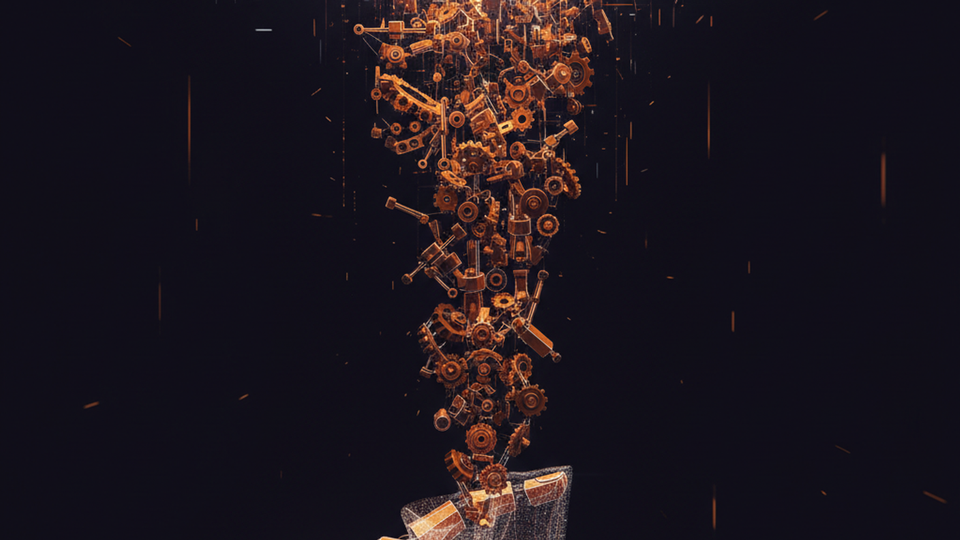
The Valley spent $10 trillion teaching language models to write emails. Now it's spending billions to teach them to fold your laundry.
The Summary
- Robotics and physical AI companies have raised over $23 billion in 2026 so far, with Nvidia launching a humanoid blueprint and OpenAI declaring robotics its next frontier
- Figure AI, valued at $39 billion, just signed a commercial deal with Catalyst Brands (JCPenney, Aéropostale, Brooks Brothers) to deploy humanoids in distribution centers
- The race is on: Nvidia, OpenAI, Meta, Tesla, and a wave of startups are competing to give AI systems physical form that can act in the real world
- "Physical AI" is Jensen Huang's term for AI that doesn't just think, it moves, builds, sorts, and operates in three dimensions
The Signal
Sam Altman's Sunday post wasn't a product launch. It was a recruiting pitch. "In the short term, we are focused on robots to support skilled workers to build our future infrastructure" reads like someone who knows datacenter construction is the bottleneck to AGI, not model architecture. OpenAI needs physical agents that can wire racks, not write poetry about them.
The timing tracks with Nvidia's humanoid robot blueprint announcement at GTC Taipei, expected late 2026 for academic researchers. This is the GPU playbook applied to bodies. Nvidia doesn't need to build the robots. It needs to become the platform every robot runs on. Give researchers a reference design, flood the market with compute-hungry humanoids, sell the chips and simulation software that make them work.
"Physical AI is the buzzword of the moment in the Valley, a term popularized by Nvidia CEO Jensen Huang to describe AI systems that can act in the physical world."
Here's what changed: language models hit an economic wall. GPT-4 can write a marketing brief, but it can't justify $200 billion in capex. Physical AI solves a different class of problem. The U.S. has 3.5 million unfilled jobs in logistics, manufacturing, and construction. Wage pressure in warehouses is real. Figure AI's commercial deal with Catalyst Brands puts humanoids in the supply chain of major retail brands. That's not a demo. That's a deployment.
The $23 billion raised this year is small compared to what's coming. Compare it to the $50+ billion that flowed into generative AI in 2023-2024. Robotics is capital-intensive in ways software never was. You need:
- Hardware manufacturing at scale
- Real-world testing environments
- Regulatory clearance for physical systems
- Insurance for machines that can hurt people
Figure AI at a $39 billion valuation shows investor appetite, but also the premium on anything that bridges the physical-digital gap. The company's May demo of humanoids sorting packages drew millions of views because people finally saw what they've been funding. Sorting boxes isn't AGI, but it's legible ROI.
The long game Altman mentioned, "everyone having a personal robot doing anything they need," is the consumer wedge. But the infrastructure play comes first. Robots building datacenters, robots assembling solar farms, robots wiring the physical layer of Web4. That's the near-term business case. The personal assistant robot is the iPhone moment, years out.
The Implication
If you're in logistics, warehousing, or any role that involves repetitive physical tasks in controlled environments, watch what Figure AI deploys at Catalyst Brands in the next six months. That's your forward indicator. If humanoids can handle variance in retail distribution, your sector is next.
For investors, the play isn't the humanoid companies. It's the picks and shovels: simulation software, sensor arrays, the chip architectures optimized for real-time physical control. Nvidia's blueprint strategy tells you where the margin lives.
For workers, the message is clear: skilled trades that involve physical problem-solving in unstructured environments are safe longer than anyone in a warehouse. The robots are coming for repetitive motion in known spaces first. If your job is "do the same thing 10,000 times in a row," start learning to program the thing that's about to replace you.