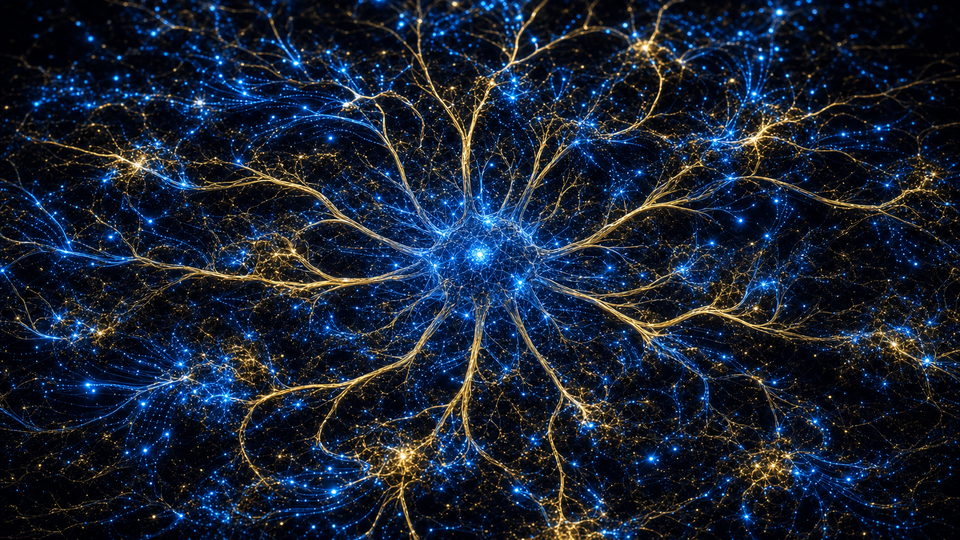
While everyone's dumping billions into training bigger models, a startup just made computational intelligence by copying something that's been optimizing networks for 500 million years.
The Summary
- Mireta Urban Dynamics built urban planning software that mimics slime mold behavior — the same organism that recreated Tokyo's rail system using oat flakes in a 2010 experiment
- The software doesn't train AI on slime mold patterns. It copies how the organism actually grows, then layers in urban data like population density and flood maps
- Cities can use it to design transit networks from scratch or optimize existing ones — Mireta's working with design firms on college campuses and metro systems
The Signal
The slime mold experiment wasn't just a neat science trick. Researchers placed oat flakes at locations matching major cities around Tokyo, and Physarum polycephalum — a single-celled organism with no brain — built a network that mirrored the actual Japanese rail system with shocking accuracy. Not approximately. Eerily similar, measuring efficiency, redundancy, and cost tradeoffs that took human engineers decades to optimize.
Mireta cofounder Raphael Kay saw something most people missed. The slime mold wasn't lucky. It was solving the same resource allocation problem cities face, just faster and without committee meetings. "Humans have been designing transportation networks for thousands of years," Kay notes, "but some organisms have been solving analogous challenges for hundreds of millions, if not billions, of years."
"This is already a form of intelligence that has been evolved over a large number of evolutionary cycles."
Here's where it gets interesting for the agent economy: Mireta isn't training neural networks on slime mold behavior. They're not scraping biological data to teach machines. They're literally implementing the growth algorithm the organism uses — how it extends pseudopods, how it reinforces successful paths, how it prunes dead ends. Then they're adding human-relevant layers on top: population heat maps, flood zones, terrain costs, political boundaries.
This is biomimicry meeting computational design. The core logic is stolen from nature. The context awareness comes from city data. AI helps build those contextual layers, but the intelligence solving the optimization problem predates machine learning by half a billion years.
Key differences from traditional AI approaches:
- No training data required for the core algorithm
- No black box problem — the logic is literally observable in a petri dish
- Computationally cheaper than running transformer models
- Optimization happens through simulation, not gradient descent
The projects Mireta's working on are still in proposal stage — a college campus road network here, a metro system there — but the approach points to a fork in how we think about machine intelligence. One path: keep scaling transformers, keep feeding them more data, keep hoping emergent capabilities appear. Other path: find optimization algorithms nature already debugged, implement them in software, wrap them in context-aware shells.
The slime mold doesn't know it's designing transit. It's just solving for "get to food efficiently while hedging against path failure." Cities are solving for "move people efficiently while hedging against floods, earthquakes, and budget constraints." Same problem structure. Different scale.
The Implication
If you're building agents, this matters. Not every problem needs a foundation model. Sometimes you need 500 million years of evolutionary pressure baked into an algorithm you can actually understand and modify. The companies winning Web4 won't just be the ones with the biggest compute budgets. They'll be the ones who know when to use a slime mold and when to use a transformer.
Watch for more biomimetic approaches in agent design. Ant colony optimization for logistics. Bacterial growth patterns for network security. Immune system logic for threat detection. Nature's already built the agents. We just need to read the code.