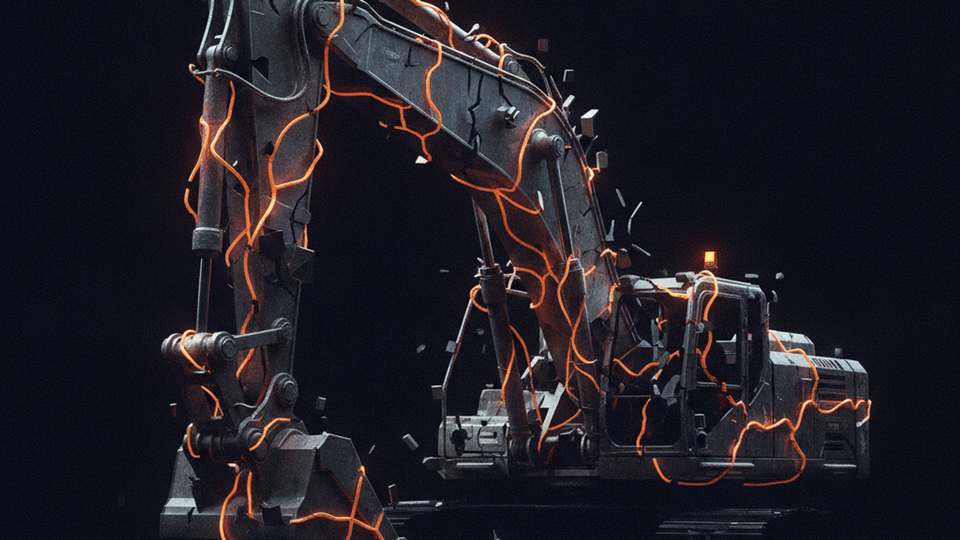
SoftBank just wrote a $200 million check to put AI in the driver's seat of excavators — not new machines, but the ones already on site.
The Summary
- SoftBank invested $200 million in Gravis Robotics, a Swiss startup retrofitting existing excavators and heavy machinery with autonomous capabilities
- The company doesn't build new robots. It upgrades the equipment already doing earth-moving work on roads, quarries, and mines.
- Physical AI is moving from the warehouse to the construction site, where labor shortages are chronic and margins are razor-thin
- The retrofit model means faster deployment and lower capital costs than replacing entire fleets
The Signal
Gravis Robotics is building software that turns dumb iron into autonomous workers. That's the bet. Not new $500,000 excavators with AI baked in from the factory. They're retrofitting the machines already on jobsites, the ones with 5,000 hours on the odometer and another 10,000 to go. CEO Ryan Luke Johns calls it "physical AI," and SoftBank's $200 million investment signals they believe construction is finally ready for the same automation wave that hit warehouses five years ago.
Construction has resisted automation longer than almost any other industry. The reasons are obvious: unstructured environments, variable terrain, weather, and work that changes site to site. But the labor math is forcing the issue. Skilled excavator operators are aging out, wages are climbing, and infrastructure spending is accelerating. Gravis is threading the needle by focusing on semi-autonomous capabilities first, not full lights-out operation.
"The funding reflects SoftBank's strong confidence in the physical AI space, particularly in automating earth-moving equipment critical to infrastructure projects."
Here's what makes the retrofit approach smart:
- Construction companies don't have to scrap existing fleets or wait for new equipment lead times
- Software updates can roll out across machines faster than hardware replacements
- Lower upfront cost means faster ROI and easier adoption on mid-size projects
Johns specifically highlighted roads, quarries, and mines as target applications. These are high-volume, repetitive earth-moving tasks where the ROI case is clearest. Dig, load, dump, repeat. Perfect for semi-autonomous operation where a human supervisor manages multiple machines instead of operating one. The work isn't going away. The 1:1 human-to-machine ratio is.
SoftBank's timing is notable. They've been burned on robotics bets before, but this one sits at the intersection of three converging forces: infrastructure spending surges in the US and Europe, chronic skilled labor shortages, and AI models that can finally handle real-world variability. The construction industry spends $10 trillion globally each year. Even single-digit automation penetration represents a massive market.
The Implication
Watch for Gravis to announce pilot programs with major construction firms in the next six months. The $200 million runway gives them time to prove the unit economics at scale, not just in controlled demos. If they can show that one operator supervising three semi-autonomous excavators delivers better margins than three operators on three machines, adoption will accelerate fast.
For workers, this isn't full replacement. It's a shift from operator to supervisor, from manual control to exception handling. The question is whether there are enough new supervisor roles to absorb the operators being automated out. Construction has always been cyclical and brutal on labor. This just changes which skills survive the next downturn.