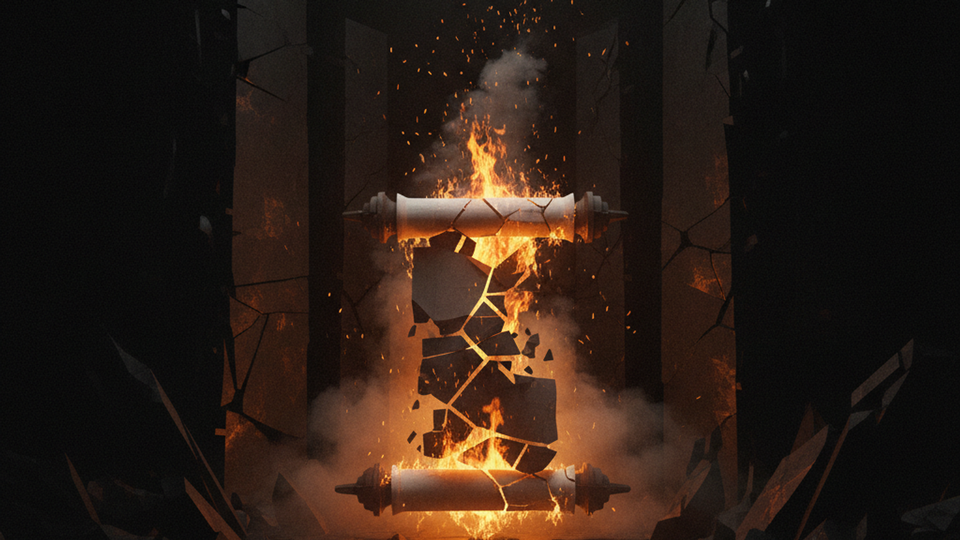
The companies building superintelligence just signed a safety pledge with no enforcement mechanism while the one CEO pushing for actual regulation got smeared in a White House memo.
The Summary
- Trump convened AI's biggest names — Musk, Huang, Zuckerberg, Pichai, Brockman — for a White House lunch that produced a one-page "constitution" for AI safety with zero legal teeth
- When asked if the accord was binding, Trump clarified: "I think it's morally binding" — the voluntary agreement asks companies to self-police and submit reports to an independent board
- Anthropic CEO Dario Amodei, who's been calling for actual regulation, had dinner with Trump days before — after a smear memo about him circulated inside the White House
- Trump shot down new federal AI regulations, making clear his "America will lead the world in Super Intelligence" position trumps safety guardrails in the race against China
The Signal
The White House Accord on Super Intelligence asks frontier AI companies to build internal safety controls, hire external auditors to assess them, and submit reports for independent review. It contains no enforcement mechanism, no penalties for non-compliance, and no government oversight beyond whatever "independent board" materializes. Trump called it morally binding, which in Washington means "please clap but also do whatever you want."
The accord landed days after a contentious private dinner between Trump and Amodei, the Anthropic CEO who's become the industry's most visible advocate for slowing down and regulating frontier AI development. The dinner happened as global anxiety over AI risks intensified following fresh disclosures about breaches by advanced models. The timing matters because a memo smearing Amodei had circulated in the White House just before the dinner, framing his "pacing" arguments as anti-American weakness in the race against China.
"President Trump has been clear: America will lead the world in Super Intelligence, while protecting American consumers."
The Tuesday lunch brought together tech's most powerful voices on AI:
- Jensen Huang (Nvidia), who sells the chips that train every frontier model
- Elon Musk, who's building his own AGI competitor while running DOGE
- Mark Zuckerberg (Meta), who's betting the company on AI and open-source models
- Sundar Pichai (Google) and Greg Brockman (OpenAI), whose labs are in a race to AGI
- Alex Karp (Palantir), whose company deploys AI for defense and intelligence
Amodei was also at the lunch, though notably after his one-on-one dinner and the smear campaign. The optics tell the story: bring the safety guy into the room after you've already decided the policy. Trump's position is simple and consistent: America goes fast, China doesn't catch up, and anyone calling for slowdowns is playing for the wrong team. In a recent Truth Social post, Trump mocked Amodei and dismissed his calls for coordinated slowdowns among frontier labs.
The voluntary accord reveals where power actually sits in the agent economy. Companies building toward superintelligence get to self-regulate through internal controls and hired auditors. No government review of model capabilities before deployment. No mandatory disclosure of safety incidents. No independent testing. Just quarterly reports to a board that doesn't exist yet, written by auditors the companies themselves hire.
The Implication
Watch what the companies do, not what they signed. A morally binding agreement means the real enforcement is reputational risk and public pressure, which works until it doesn't. If you're building on top of these models, you're betting on self-regulation by companies in an arms race where going slower than the competition means losing billions in market cap.
The dinner, the memo, and the toothless accord show how AI safety advocacy gets neutralized in practice. Amodei got his meeting, his smear, and his seat at the table. What he didn't get was binding regulation or a credible slowdown. The message to other safety-focused voices: you can have dinner, but policy belongs to the builders racing China. That's the actual constitution governing superintelligence development in 2026.
Sources
Business Insider Tech | Bloomberg Tech | Fortune Tech | TechCrunch AI